



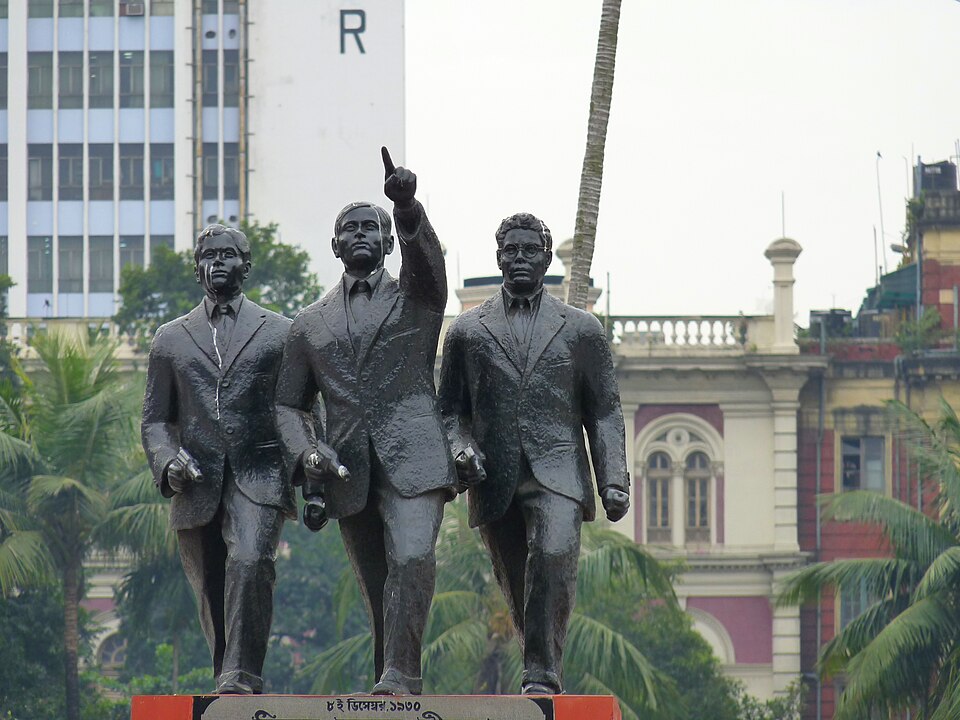
The history of India’s struggle for independence is illuminated by the sacrifice of those young revolutionaries who embraced death with a smile, believing that martyrdom was the final, most blazing signature of their love for the motherland. Among these luminous figures stand the Bengal Volunteers revolutionaries—Major Benoy Basu, Lieutenant Badal Gupta, and Captain Dinesh Gupta—whose heroic assault on the Writers’ Building on December 8, 1930, remains one of the most daring, disciplined, and morally resolute acts of anti-colonial defiance. Their valiance did not merely shake the British Raj; it electrified a nation and immortalised their names in the grand narrative of India’s revolutionary movement.
By the late 1920s, Bengal had turned into a crucible of revolutionary energy. The brutal repression unleashed by the Imperial Police and the notorious British officers had created deep resentment among the youth. The Bengal Volunteers, formed by Subhas Chandra Bose during the 1928 Calcutta Session of the Indian National Congress, soon crystallised into a militant organisation committed not only to political resistance but to armed struggle in defence of national honour.
The repressive policies of oppressive officers like Colonel NS Simpson, the Inspector General of Prisons, symbolised the systemic cruelty of the colonial state. Reports of savage torture inflicted upon political prisoners—beatings, starvation, solitary confinement—spread like wildfire among students and youth. It was clear to the Bengal Volunteers that symbolic protest would not suffice. An act of retribution—precise, disciplined, and morally justified—was necessary to awaken the conscience of the nation.
The target chosen was both strategic and symbolic—the Writers’ Building, the nerve-centre of British bureaucratic control in Bengal. Eliminating Simpson was not merely retribution; it was a blow meant to declare that injustice, when wielded by a foreign power, would not remain unanswered.
Benoy, Badal, and Dinesh, all barely in their early twenties, planned the operation with military precision. Their ranks—Major, Lieutenant, and Captain—were not honorary titles but reflections of their discipline and their deep sense of mission. They were soldiers of a nation yet to be born.
On a crisp December morning, wearing European clothes to avoid identification, the trio entered the Writers’ Building with concealed pistols and capsules of potassium cyanide. Their hearts steady, their purpose unshakeable, they walked toward history.
Inside the building, they confronted and shot Colonel Simpson, ending the career of the man synonymous with cruelty toward Indian revolutionaries. Panic erupted in the corridors, but the young men did not flee. Instead, they took positions and held off the armed police in an intense gunfight. The air reverberated with gunshots, smoke, and the fierce pulse of resistance.
Surrounded by a formidable contingent of British police and realising capture was imminent, the revolutionaries faced the moment they had always been prepared for.
Benoy Basu, grievously injured, shot himself to avoid falling into British hands.
Badal Gupta consumed cyanide after exhausting his ammunition, choosing death over surrender.
Dinesh Gupta, though severely wounded, fought until the last bullet and attempted to follow his comrades in choosing martyrdom. He survived the encounter but was arrested, tortured, and hanged on 6 July 1931 by the colonial government.
They had walked into the Writers’ Building knowing that they would never walk out again. Their bodies fell, but their martyrdom rose like a flame that would not be extinguished.
The sacrifice of Benoy, Badal, and Dinesh was not an isolated act of violence; it was an act rooted in moral clarity. The British state had normalised oppression—arbitrary arrests, custodial torture, lathi-charges, and shoot-on-sight orders. By striking at the apex of this machinery, the Bengal Volunteers made a larger declaration: tyranny, when organised and justified in the name of empire, forfeits its own legitimacy.
Their martyrdom resonated because it emerged from a profound ethical conviction. They rejected passive acceptance of injustice, choosing instead the hard, perilous path of armed resistance. They believed that dignity is indivisible and that the cost of freedom, even if paid in blood, was a price worth paying for future generations.
The events of December 8, 1930, sent a shockwave throughout India. Newspapers, despite colonial censorship, could not suppress the magnetism of their sacrifice. The youth of Bengal erupted in massive demonstrations, strikes, and processions, holding portraits of the martyrs aloft as symbols of national resurgence. British officers reported a sudden surge of “dangerous patriotism” among students, a phrase that revealed more truth than intended.
The fearless defiance of the trio inspired a generation of revolutionaries. It rekindled the flame of nationalism at a time when despair and political disillusionment had begun to creep in. In countless homes, poems were composed, songs were written, and whispered stories of their bravery became part of Bengal’s collective consciousness.
The site of their final stand became a monument of remembrance. To honour their memory, Dalhousie Square—the colonial administrative centre—was renamed B.B.D. Bagh, after Benoy, Badal, and Dinesh. The name stands not merely as a tribute, but as a reclamation of space that once symbolised imperial authority. The Writers’ Building, forever associated with the deafening echo of their gunfire, now carries the scent of their sacrifice.
What makes the valiance and martyrdom of these three revolutionaries immortal is not only their courage in the face of death, but the purity of their intent and the thunderous clarity of their mission. They were not seeking glory, fame, or personal triumph. They offered their lives with quiet, unwavering determination, believing that their death would strengthen the spine of a nation rising against centuries of foreign domination.
Benoy, Badal, and Dinesh stand today as embodiments of youthful fearlessness, uncompromising patriotism, and moral rebellion. Their story serves as a luminous reminder that freedom is never granted—it is seized by those who dare to resist unfreedom with the might of their conviction.
On December 8, 1930, three young men rewrote the grammar of resistance. Their martyrdom became a rallying cry, their bravery a beacon, their lives a scripture of sacrifice. Empires crumble, flags change, generations move on—but the memory of their valiance remains etched forever in the heart of Bengal and the soul of India.
Their final act at the Writers’ Building stands not merely as an episode in history, but as an eternal declaration: that when tyranny darkens the sky, even three determined youths can become lightning.